A useful squint assessment does more than confirm that one eye turns: it measures how the eyes behave at different distances, whether the deviation is constant, and how well each eye sees and works with the other. By the end, you will know how clinicians match glasses, prisms, patching, exercises, injections or surgery to the actual alignment pattern, visual goal and practical demands of treatment.
Key takeaways
- A complete assessment tests each eye’s vision, refraction, alignment and movement.
- Glasses, prisms, exercises or surgery depend on the cause and alignment pattern.
- Treating eye alignment does not replace treatment for amblyopia, or lazy eye.
- Seek urgent care for sudden double vision, severe eye pain or a new squint.
What happens during a complete squint assessment?
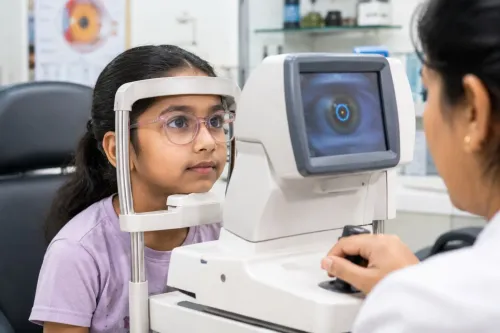
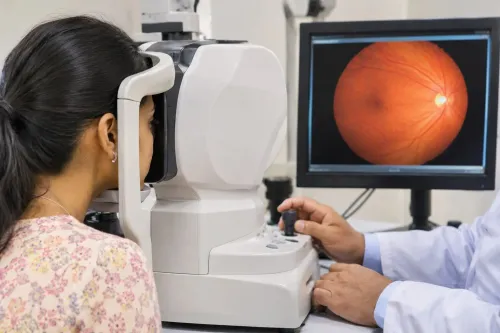
A complete squint assessment measures alignment, vision and eye movements rather than relying on a photograph. The specialist performs visual acuity testing for each eye, checks refraction, and examines how the eyes work together at distance and near.
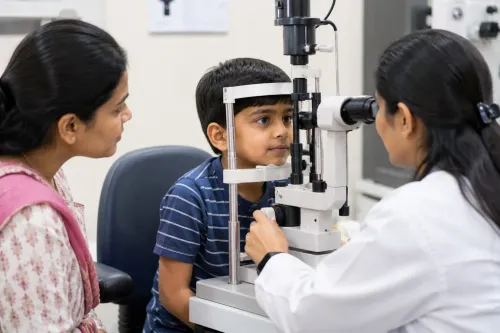
- The cover-uncover test at distance and near identifies a manifest deviation. The examiner covers one eye, watches the uncovered eye for a correcting movement, then repeats the process on the other side. A movement means that eye was not pointing at the target.
- The alternate-cover test breaks binocular fusion by moving the cover between the eyes. A prism bar is placed before one eye until the refixation movement stops; the prism strength, recorded in prism dioptres, quantifies the deviation.
- An uncovered eye that is misaligned throughout fixation indicates constant strabismus. If alignment breaks only during tiredness, inattention or particular viewing conditions, the pattern is intermittent.
- A latent deviation appears only when fusion is interrupted, so the eyes look aligned during ordinary binocular viewing but drift under alternate cover.
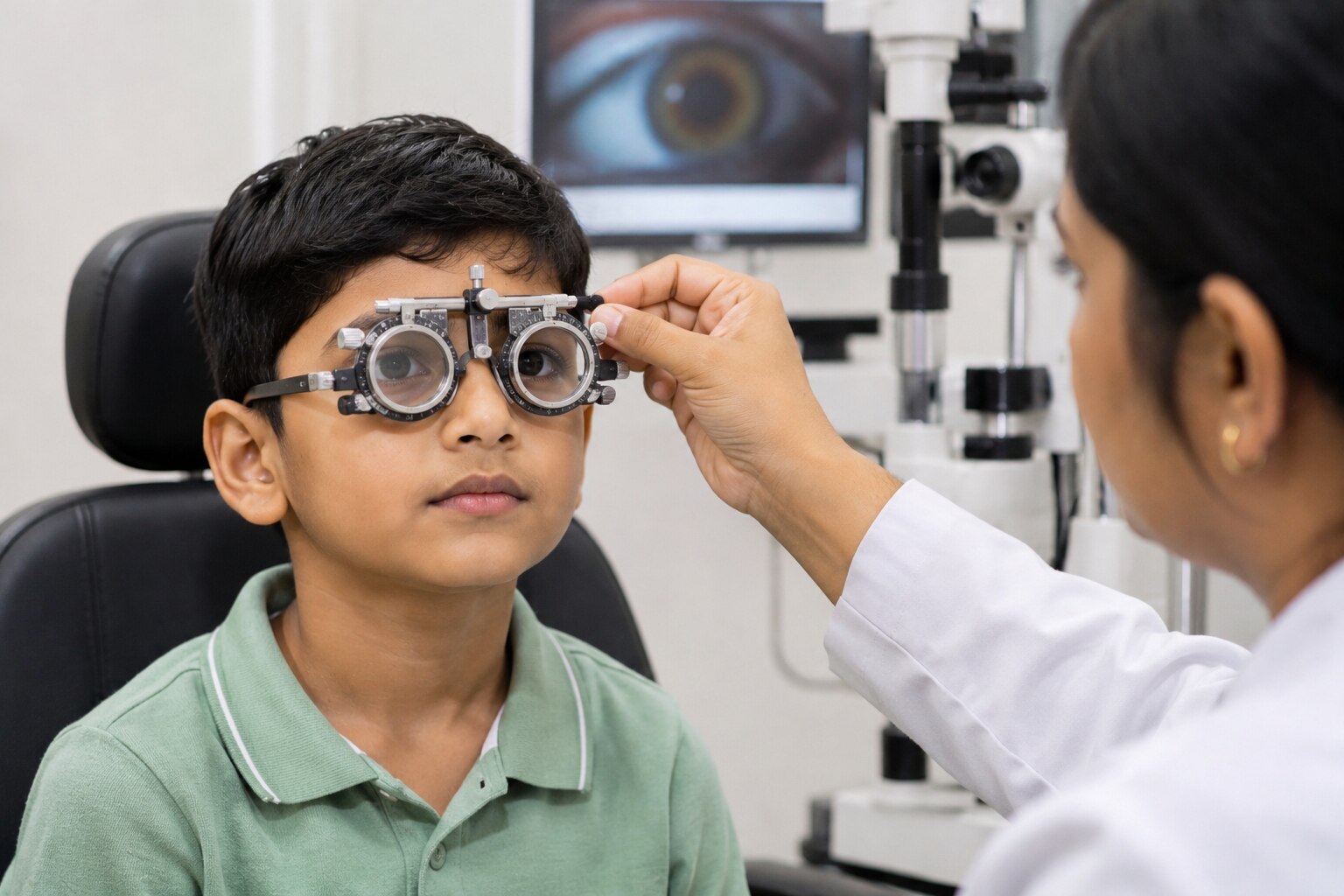
The specialist also checks ocular motility in several directions, comparing movement between the eyes and looking for restricted or overactive muscles. Testing at distance and near matters because the deviation can change with viewing demand. Refraction often follows cycloplegic drops in children, which temporarily relax focusing and prevents hidden long-sightedness from distorting the measurement.
Binocular testing assesses fusion, depth perception and whether double vision is present.
How do clinicians choose between glasses, prisms, exercises and surgery?
The choice follows the deviation’s cause, size, pattern and effect on vision. A small, variable turn needs a different plan from a large, constant deviation, and treatment for double vision is not the same as treatment for weak visual development.
| Option | Main target | When it fits | What it cannot do |
|---|---|---|---|
| Prescription glasses for squint | Refractive error and accommodative turning | In accommodative esotropia, correcting hyperopia can substantially reduce or eliminate the inward turn | It will not correct a significant residual deviation after proper wear |
| Prism lenses | Double vision and image fusion | Small or variable deviations, or when surgery is unsuitable | They bend light but do not cure the muscle imbalance; large or changing turns can make spectacles thick or ineffective |
| Orthoptic exercises | Fusional control and binocular coordination | Selected problems such as convergence insufficiency or difficulty controlling an intermittent deviation | They do not replace surgery for a large, constant structural misalignment |
| Surgery | The size and pattern of persistent eye deviation | A clinically significant turn remains despite suitable glasses, or alignment is unlikely to improve with exercises or prisms | Straight eyes do not automatically restore acuity or normal depth perception |
Surgery changes muscle balance to improve alignment and may support binocular vision, but it does not treat amblyopia by itself. Exercises aim mainly to improve control, while prisms aim mainly to relieve symptoms.
A clinician may also consider botulinum toxin for a particular pattern, but its effects can be temporary or variable and it is not a universal substitute for muscle surgery.
Why alignment treatment and amblyopia treatment are not the same
Straightening the eyes does not automatically equalise what each eye sees. Amblyopia is reduced visual development caused by the brain favouring one eye, while strabismus describes the eyes pointing in different directions.
Strabismus surgery changes the pulling balance of the eye muscles; it does not repair the retina, optic nerve or visual cortex that processes sight.
A persistent visual acuity difference after alignment treatment can therefore reflect untreated amblyopia. Cataract, optic-nerve disease or another eye condition can also limit vision, so a straight appearance does not prove that both eyes see equally well.
The goals need to be separated:
- Alignment treatment changes eye position and may improve appearance, double vision or the chance of using both eyes together.
- Amblyopia treatment trains the brain to use the weaker eye, usually after correcting an important refractive error with glasses.
- Binocular treatment aims to develop coordinated use of both eyes and depth perception; straight eyes alone do not guarantee normal binocular vision.
Patching covers the stronger eye for a prescribed patching schedule, forcing the weaker eye to work during visual tasks. For many children with moderate amblyopia, two hours daily with near activities can work as well as six hours, but severe or persistent amblyopia needs individual review. Increasing patching without guidance is not automatically better.
Atropine penalisation places prescribed atropine in the stronger eye, temporarily blurring its near focus so the weaker eye receives more visual work. Follow-up checks visual acuity in each eye and adjusts treatment rather than relying on alignment alone.
What should you expect from treatment in daily life?
Expect treatment to involve more than straighter eyes: compare the daily effort, review schedule, risks and measurable goals before choosing a plan. Ask how it will affect reading, driving, work, sport, head posture and social confidence.
| Option | Daily effort and follow-up | Side effects or limits | Outcomes to track |
|---|---|---|---|
| Glasses or prisms | Wear them consistently; attend refraction and alignment reviews | Prisms do not correct the muscle imbalance; changing or large deviations can make lenses thick or ineffective | Visual acuity, comfort, head posture and relief from double vision |
| Exercises or patching | Requires regular home practice or prescribed patching; progress needs monitoring | Benefits depend on the deviation and visual development; patching can temporarily blur or irritate the covered side | Intermittent strabismus control, acuity in each eye and binocular function |
| Botulinum toxin for strabismus | Usually involves an injection and reassessment as the effect develops or wears off | Results can be temporary or variable; temporary drooping or vertical misalignment can occur | Angle, eye movements, alignment stability and double vision |
| Strabismus surgery | Plan for appointments, activity restrictions and strabismus surgery recovery | Undercorrection, overcorrection, recurrence or another operation remain possible | Residual angle, appearance, head posture, binocular function and diplopia |
Double vision treatment aims to restore comfortable single vision, not simply improve appearance. Adults with long-standing suppression may gain alignment and a wider useful binocular field without recovering normal depth perception.
Follow-up matters because alignment changes with growth, fatigue and time. Keep records of control, diplopia frequency, visual acuity and head posture; these measures reveal whether treatment is helping your daily function.
How to prepare for a squint consultation and recognise urgent changes
Bring your previous spectacle prescription, current glasses, medication list, medical history and dates of earlier eye problems. Add photographs showing the eye turn, notes about when it appears, and a record of headaches, eye strain, head tilting or double vision.
- Seek prompt assessment for a new squint in adults, sudden double vision, a rapidly worsening deviation or an eye turn with reduced vision.
- Treat sudden double vision with severe headache, weakness, numbness, speech trouble, an abnormal pupil or vision loss as an emergency.
- Tell the specialist whether double vision disappears when either eye is covered, whether symptoms fluctuate with tiredness, and whether diabetes, thyroid disease, trauma or neurological illness is present.
During the visit, expect visual-acuity testing for each eye, refraction, eye-movement assessment and cover–uncover and alternate-cover tests at distance and near. Children often need cycloplegic drops so hidden long-sightedness does not distort the prescription.
A squint treatment consultation in Thane should end with a measurable plan: the deviation’s type and size, the role of glasses, a prism trial, exercises, patching or surgery, and the review date. Glasses may reduce an accommodative inward turn; prisms can relieve diplopia but do not correct the muscle imbalance.
Focus Eye Clinic - 02235048608 can use these findings to distinguish symptom relief from treatment aimed at alignment or visual development.
Related service
Ophthalmology ₹900 Squint treatment at Focus Eye Clinic by Dr. Mohini Modak focuses on correcting eye misalignment (strabismus) to improve vision and appearance. View service → |
Frequently asked questions
What happens during a complete squint assessment?
The specialist tests visual acuity in each eye, checks refraction, measures alignment at distance and near, and examines eye movements and binocular function.
How do clinicians choose between glasses, prisms, exercises and surgery?
Choice depends on the type and size of the deviation, focusing problems, eye movement findings, symptoms, age and whether the squint is stable.
Why are alignment treatment and amblyopia treatment different?
Alignment treatment aims to make the eyes point together, while amblyopia treatment improves vision in an eye that has not developed normal visual strength.
What should you expect from squint treatment in daily life?
Treatment may improve eye position, reduce double vision or strain, and support depth perception, but results and adjustment time depend on the underlying condition.
When should you seek urgent assessment for a squint?
Arrange urgent assessment for sudden squint or double vision, severe eye pain, vision loss, a drooping eyelid, unequal pupils or neurological symptoms.
Keywords