A child can have unequal vision, impaired depth perception, or an eye condition without saying that anything is wrong. By recognising age-specific warning signs and knowing which symptoms require same-day care, you can arrange the right examination instead of waiting for a routine screening or a child’s complaint.
Key takeaways
- Constant, new, or increasingly frequent eye crossing needs evaluation.
- Arrange assessment when vision changes persist, recur, or worsen.
- Seek same-day care for sudden vision loss, severe eye pain, or a new abnormal eye movement.
- A normal screening result does not end evaluation when concerns continue.
Warning signs from infancy through the school years
An eye evaluation is warranted when alignment, visual behaviour, or movement changes persist, recur, or worsen. Infant eye wandering can occur during the first four months, but constant crossing, new crossing, or intermittent crossing that becomes more frequent needs assessment.
Do not wait for a child to complain: unequal prescriptions can cause amblyopia without obvious blur.
| Age | Warning signs | What to do |
|---|---|---|
| Birth to 4 months | Poor eye contact, poor tracking, a dull or unequal red reflex, or an abnormal red reflex | Arrange prompt assessment, especially if either eye does not follow a face or toy |
| Any age | A white pupil in photographs, a grey or yellow pupil, or a reflex that differs between eyes | Seek same-day ophthalmic assessment; repeated leukocoria is not safely dismissed as camera glare |
| 4 months to preschool | Persistent eye crossing, an eye drifting outward, frequent closing or covering of one eye, head tilting, light sensitivity, or sitting unusually close to screens | Book a complete pediatric eye examination |
| Preschool to school years | Poor tracking vision warning signs, clumsiness, headaches after near work, or a noticeable difference between the eyes | Arrange evaluation even after a passed screening test |
| School years | Difficulty seeing the board, squinting, losing place while reading, or holding books very close | Tell the teacher and book an eye examination |
Sudden vision loss, severe eye pain, eye trauma, a new drooping eyelid, or sudden double vision needs emergency assessment rather than a routine appointment.
When normal-looking behaviour can hide a vision problem
A child can function well with useful sight in one eye while the other eye develops poor vision. Long-standing blur from hyperopia, myopia, or astigmatism is often accepted as normal, and anisometropia, or a large prescription difference between the eyes, can make one eye do most of the work.
This unequal vision creates amblyopia risk and reduced depth perception without a child reporting blurred sight.
Arrange an evaluation when your child seems to see normally but you notice:
- One eye appears to work differently, even if the child reads, plays, and moves around normally. Children often compensate with the clearer eye, hiding reduced vision in the other.
- A photograph shows a dull, white, absent, or markedly different red reflex between the eyes. This finding can indicate a cataract or another opacity blocking a clear image.
- Eye crossing continues after about 4 months, appears suddenly, or becomes more frequent. Useful vision in both eyes does not remove the risk of amblyopia or loss of binocular vision.
- A screening test is failed or incomplete, or you remain concerned after a passed screen. Photoscreening and visual-acuity checks estimate risk; they do not measure refraction, alignment, eye health, and amblyopia risk as directly as a complete examination.
A pediatric eye specialist can assess children who cannot describe blur by testing each eye, examining the red reflex, measuring focusing power and alignment, and checking how the eyes work together. Waiting for a complaint can allow abnormal visual development to become harder to correct.
Symptoms that need same-day or emergency assessment
A white pupil is a white pupil emergency: arrange immediate ophthalmic assessment, especially when it appears in ordinary light or repeatedly in photographs. Do not wait for a routine appointment.
Sudden vision loss, severe eye pain, a new fixed eye deviation, sudden double vision, a new drooping eyelid, marked swelling, or significant eye trauma also need same-day emergency assessment.
| Symptom | Why it cannot wait | Immediate action |
|---|---|---|
| White, grey, yellow, or unequal pupil reflex | Cataract, retinal disease, or retinoblastoma can produce it | Go to emergency ophthalmic care |
| Sudden vision loss, severe pain, or sudden double vision | A sight-threatening or neurological problem needs rapid assessment | Seek emergency care now |
| Eye trauma, bleeding, or an object stuck in the eye | Rubbing or pressing can worsen internal damage | Cover loosely; do not remove the object |
| Chemical splash | Chemical injury continues until the chemical is removed | Flush continuously with clean water while seeking help |
For a chemical exposure, hold the eyelids open and rinse with copious clean water immediately; do not delay to identify the chemical. After blunt or penetrating eye trauma, keep the child still, avoid food if surgery could be needed, and take the product container or injury details to the emergency team.
If the child cannot describe the change, trust sudden behaviour differences such as covering one eye, refusing light, or losing balance.
When children need their first examination and what it includes
Arrange a first eye examination at about 6 months, repeat it at age 3, and have another before school starts. Book it earlier for eye crossing after 4 months, unequal-looking pupils, a drooping eyelid, an abnormal screening result, developmental delay, or a family history of strabismus.
- Ask about a specialist examination sooner if the child was born prematurely. Prematurity and retinopathy of prematurity require separate assessment; screening is recommended for infants weighing 1,500 g or less at birth or born at 30 weeks 6 days or less, with selected higher-risk infants also included.
- Take a photograph showing a white, yellow, grey, or asymmetric pupil reflex seriously and arrange prompt ophthalmic assessment.
- Request evaluation when a child frequently covers one eye, tilts the head, sits close to screens, loses track of moving objects, or cannot use both eyes together.
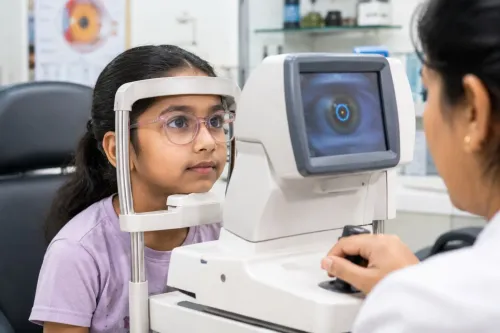
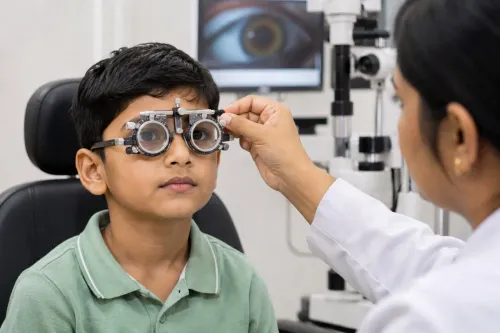
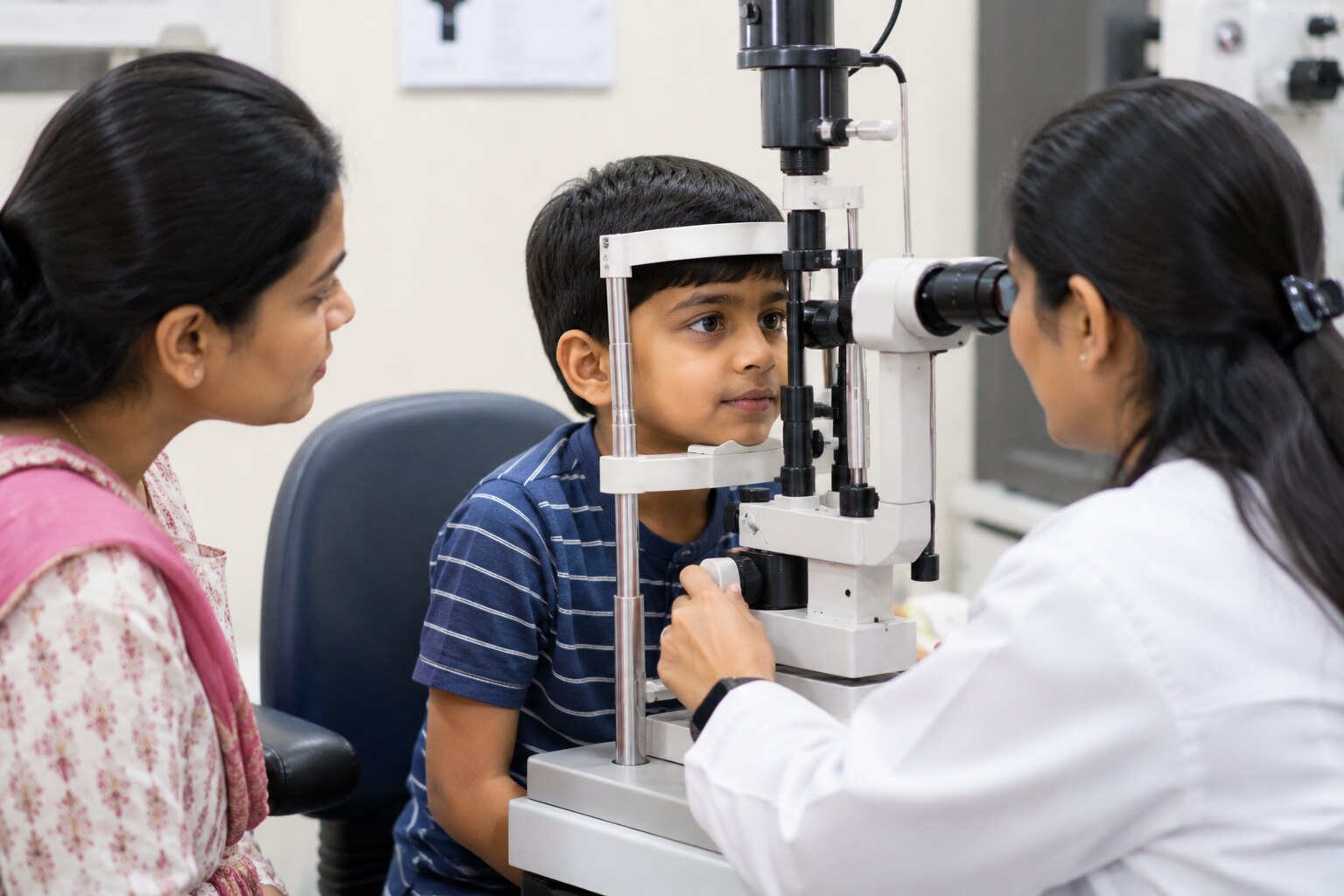
A child does not need to read letters for a specialist to measure vision. The examiner can use preferential-looking cards, matching pictures or symbols, and age-appropriate fixation tests, sometimes testing each eye separately with an eye patch.
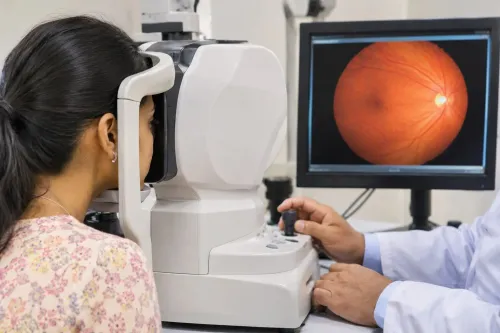
Photoscreening or an autorefractor estimates risk; a complete examination adds eye alignment, pupils, eye movements, red reflex, ocular health, and cycloplegic refraction, which temporarily relaxes focusing. Dilation helps reveal cataract, retinal disease, and other causes of amblyopia.
Why screening is not enough when a concern persists
An abnormal or incomplete result from photoscreening, autorefraction screening, or school vision screening calls for a diagnostic examination, not reassurance or repeated screening alone. Arrange a visit with a paediatric eye specialist who can measure each eye’s refraction, alignment, ocular health, and risk of amblyopia.
Bring the screening report and note when you first noticed the change.
A passed screen does not cancel a specific concern. Screening can miss a problem when a child cooperates poorly, only one eye is affected, or the test does not cover the suspected condition. Ask for an examination if you notice:
- Squinting, closing, or covering one eye
- Eye crossing that is constant, newly appearing, or becoming more frequent
- An unusual head tilt or turn
- Persistent difficulty tracking a moving object
- A clear difference between the eyes in photographs or daily behaviour
- Sitting unusually close to screens, headaches, or difficulty seeing the board
Do not wait for a child to complain. Amblyopia can develop when the brain relies on the clearer eye, leaving the child unaware of reduced vision or depth perception. In Thane, Focus Eye Clinic - 02235048608 can help assess suspected squint, unequal refraction, or amblyopia and determine whether further treatment is needed.
A white pupil, sudden vision loss, severe pain, or a fixed new deviation needs urgent assessment rather than a routine screening appointment.
Related services
Ophthalmology ₹900 Squint treatment at Focus Eye Clinic by Dr. Mohini Modak focuses on correcting eye misalignment (strabismus) to improve vision and appearance. View service → |
Ophthalmology ₹900 Amblyopia, commonly known as lazy eye, requires timely and specialized care to restore optimal vision. View service → |
Frequently asked questions
What vision warning signs should parents watch for in children?
Watch for persistent or worsening eye misalignment, unusual visual behaviour, changes in eye movement, and difficulty using vision during play, reading, or schoolwork.
When does a child need same-day or emergency eye assessment?
Seek same-day or emergency assessment for sudden vision loss, severe eye pain, a new abnormal eye movement, a significant eye injury, or a red painful eye with vision changes.
When should a child have their first eye examination?
Children need an examination when a parent notices a concern, even if the child passed screening. The examination assesses alignment, eye movement, visual responses, focusing, and eye health.
Why is vision screening not enough when a concern persists?
Screening is a brief check, while a specialist examination investigates persistent symptoms, alignment, focusing, eye movement, and the health of each eye.
Related services
Ophthalmology Eye Spectacles check up at Thane ₹900 Experience clarity and comfort with a comprehensive eye number check-up at Focus Eye Clinic, Thane. Led by Dr. View service → |
Ophthalmology ₹900 Retinal check-up at Focus Eye Clinic by Dr. Mohini Modak is essential for early detection of serious eye conditions that can affect vision. View service → |
Ophthalmology ₹900 At Focus Eye Clinic in Thane, Dr. Mohini Modak provides specialized care for uveitis, an inflammatory condition that can lead to permanent vision... View service → |
Ophthalmology ₹900 Gonioscopy is a specialized diagnostic procedure used to examine the drainage angle of the eye, where the iris meets the cornea. View service → |
Keywords