A child’s prescription becoming stronger is not, by itself, enough to prove that the eye is lengthening or that myopia control is working. By the end, parents will know which measurements matter, how clinicians confirm genuine progression, when reviews are needed, and what information to bring to each visit.
Key takeaways
- Progressive myopia means the prescription increases as the eyeball elongates.
- Bring previous prescriptions, eye reports and your child’s current glasses.
- Clinicians compare consistent measurements before confirming true progression.
- Regular reviews help match myopia control to your child’s changing eyes.
What progressive myopia means and which children face higher risk
Progressive myopia in children means nearsightedness continues to increase between eye examinations, usually because the eyeball is elongating. It differs from a stable spectacle prescription that remains similar across visits.
A stronger prescription can make the classroom board, teacher’s writing and distant demonstrations harder to see, while ongoing elongation increases later risks such as retinal tears, retinal detachment, myopic macular damage and glaucoma.
| Pattern | What it means | Why it matters |
|---|---|---|
| Stable prescription | Spectacle power remains similar across visits | Correction usually maintains clear distance vision |
| Progressive childhood myopia | Nearsightedness keeps increasing, usually with axial elongation | More frequent review is needed to track structural change and visual risk |
Progression commonly occurs from the early school years through adolescence. Earlier onset predicts a longer period of progression, and younger myopic children generally progress faster than older children. Key myopia risk factors include a parental myopia family history, limited outdoor time, prolonged near work and early onset.
Outdoor time has stronger evidence for reducing new myopia cases in children who are not yet nearsighted than for stopping established progression. An already myopic child still needs measured follow-up; outdoor activity is not a substitute for monitoring or treatment.
A clinician should compare repeated prescriptions and eye length with age-appropriate expectations rather than judge progression from one changed number.
How the first visit establishes a reliable myopia baseline
A reliable myopia baseline assessment is more than an ordinary eye-number check: it creates repeatable optical, structural and health records for comparison at later visits. The aim is to identify both the prescription and whether the eye is lengthening.
- Distance visual acuity and best-corrected visual acuity in each eye
- Cycloplegic spherical-equivalent refraction
- Axial length measurement in millimetres using optical biometry
- Corneal measurements, including curvature
- Eye alignment and binocular vision
- Medical and family history, including parental myopia
- Anterior-segment examination
- Dilated retinal examination
Cycloplegic refraction in children uses eye drops to temporarily relax accommodation. This prevents active focusing from making a non-cycloplegic result appear more myopic than the child’s true refractive error. Record the cycloplegic agent, the timing of the drops and measurement, and whether the result can be compared with earlier visits.
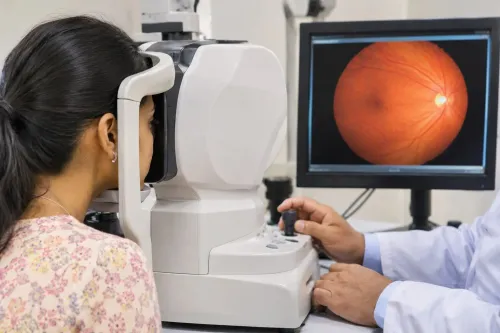
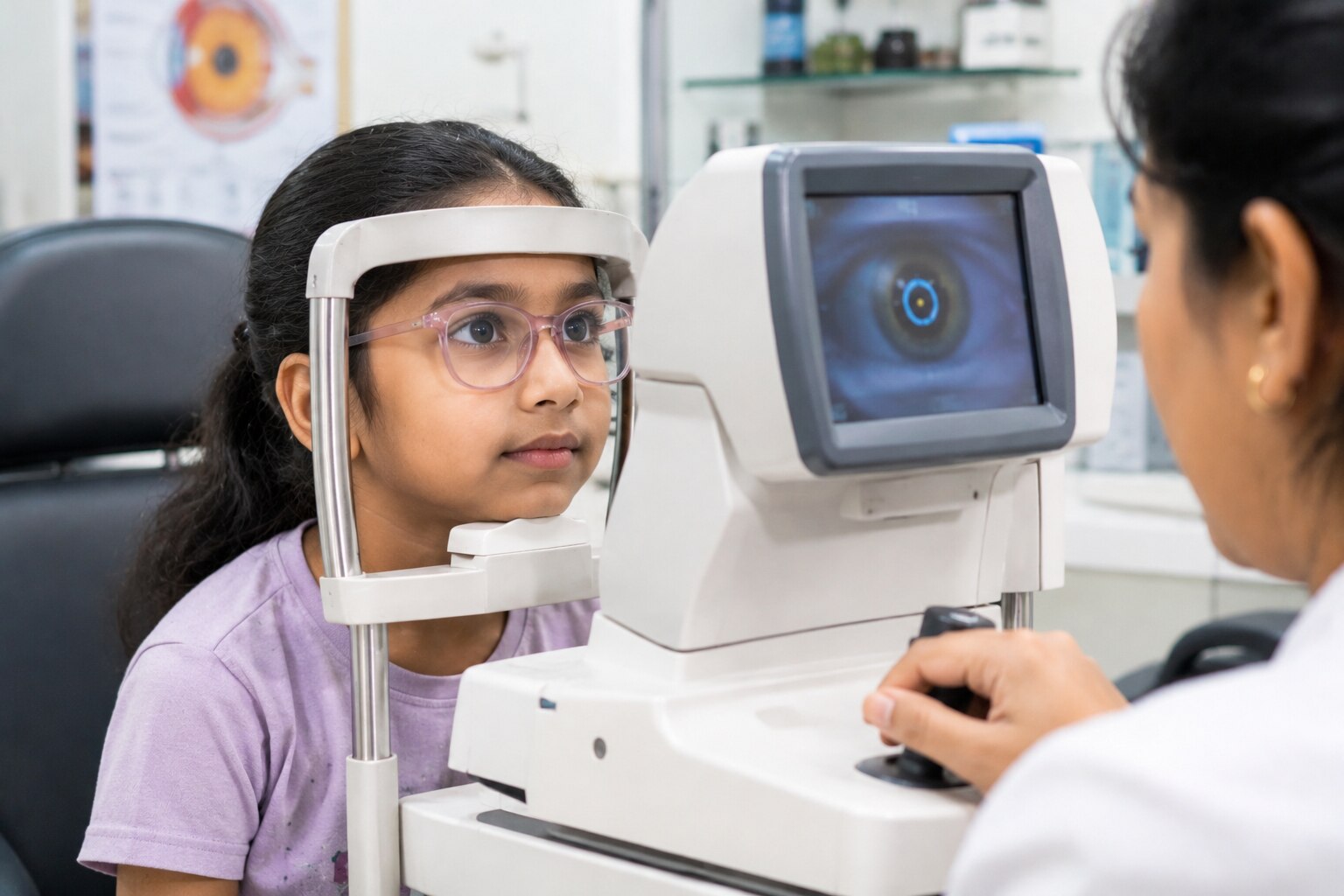
Optical biometry measures axial length without relying on the spectacle prescription alone. Using the same instrument and a consistent technique improves comparison between visits, because a small change in millimetres can matter when monitoring eye growth. The record should also note test quality and any factor that could make a measurement unreliable.
How clinicians tell real progression from a misleading result
Real progression is established by comparing cycloplegic spherical-equivalent refraction with axial length, not by accepting a stronger prescription as proof. Refraction records the optical prescription; axial length, measured in millimetres, tracks axial elongation, the structural change driving most childhood myopia.
A few tenths of a millimetre over a year can matter in a child. Reliable myopia progression monitoring therefore uses the same optical biometer, consistent technique and repeatable measurements, interpreted against age-appropriate expectations. Younger myopic children generally progress faster than older children.
| Finding | What it may mean | Clinician’s response |
|---|---|---|
| Prescription stronger, axial length unchanged | Optical or testing variation remains possible | Repeat cycloplegic refraction and verify the current prescription |
| Axial length increased, prescription similar | Structural progression may precede a clear prescription change | Recheck biometry and compare with earlier scans |
| Both increased consistently | Progression is more credible | Assess treatment response and adherence |
When results conflict, the clinician repeats any inconsistent test rather than treating one number. They review spectacle compliance, confirm that the prescribed lenses are accurate and current, and consider concentration, fatigue or poor understanding during visual-acuity testing.
The decision also includes eye alignment, binocular vision, corneal health and dilated examination findings. A change caused by corneal disease, poor cooperation or an unrelated retinal finding needs a different response from ordinary childhood progression. No treatment decision should rest on refraction or axial length alone.
How often a child needs review and what parents should bring
A six-month eye examination is the usual starting point in a myopia control follow-up schedule, whether the child is being monitored or receiving treatment. Use a three-month review after treatment begins, when results are uncertain, or when the clinician needs an early safety check.
Reserve a twelve-month interval for a child with stable, well-documented findings and lower monitoring concern. It is not a substitute for treatment follow-up. Judge treatment efficacy over at least 12 months because short-term fluctuations in refraction, testing and cooperation can mislead.
For what to bring to a child eye appointment, prepare this checklist:
- Previous prescriptions, including the date and whether they were made after cycloplegic refraction.
- Old axial-length reports, if available, so measurements can be compared over time.
- Current spectacles, plus contact-lens details such as the lens type, wearing schedule and replacement routine.
- School observations about board visibility, squinting, headaches or moving closer to read.
- A treatment-use record covering atropine doses, missed doses and any side effects.
- Average daily spectacle or contact-lens wearing hours.
- Typical outdoor time and near-work habits, including reading, homework and recreational screen use.
Bring the actual records rather than relying on memory. Consistent details help the clinician separate true progression from missed treatment, changing wear habits or an unreliable measurement.
How monitoring guides safer myopia-control decisions
A treatment choice should follow two measurements: cycloplegic spherical-equivalent refraction, which records the optical prescription, and axial length, which tracks the eye’s structural elongation. Compare repeatable results from the same instrument and technique; a prescription change alone cannot show whether progression is accelerating.
| Option | What monitoring shows | Key trade-off |
|---|---|---|
| Low-dose atropine for myopia | The two-year LAMP trial found 0.05% more effective than 0.025% and 0.01% for reducing spherical-equivalent progression and axial elongation | The higher concentration caused more light sensitivity and near-vision effects |
| Multifocal myopia-control lenses | Specially designed multifocal spectacles or contact lenses can slow average progression in selected children | Benefit is partial, not a guarantee that myopia will stop |
| Orthokeratology | Overnight corneal reshaping can slow progression in selected children | Requires strict hygiene, corneal checks and confirmation that axial elongation is slowing |
Orthokeratology safety for children depends on removing lenses correctly, washing and drying hands, using fresh approved solution, and never using tap water. Stop lens wear and seek prompt eye care for pain, redness or reduced vision; microbial keratitis can threaten sight.
Laser refractive surgery later in life changes corneal focusing power. It does not shorten an elongated eye or remove the retinal risk associated with high myopia.
Focus Eye Clinic - 02235048608 is useful when it repeats comparable measurements, reviews adherence and safety, and adjusts care from documented change rather than prescription alone.
Frequently asked questions
What does progressive myopia mean in children?
Progressive myopia means a child’s nearsightedness increases between eye examinations, usually because the eyeball is elongating.
How is a child’s myopia baseline established?
The first visit records the child’s vision and examination findings, creating measurements for comparison at later reviews.
How do clinicians distinguish true myopia progression from a misleading result?
Clinicians compare results from consistent examinations with earlier prescriptions and reports before deciding that myopia has progressed.
What should parents bring to a myopia monitoring appointment?
Bring previous prescriptions, eye examination reports and the child’s current glasses so the clinician can compare the results.
Keywords